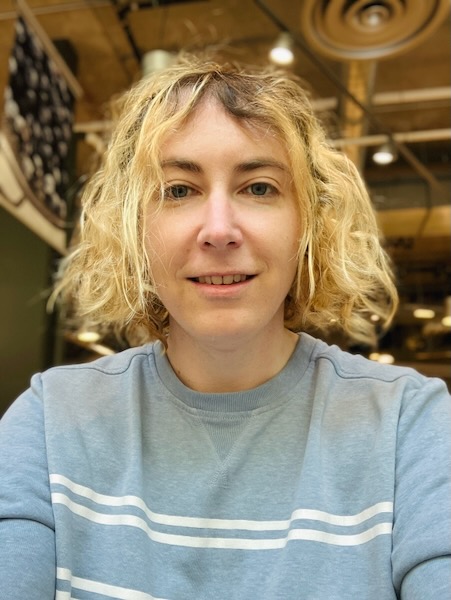
My name is Dielle Lundberg (she/her), and I am a writer and data analyst studying ableism in health care and other topics in public health. I am working to challenge structural ableism in public health and healthcare through peer-reviewed research, independent research briefs, and essay series. I also confront ableism through my practice as a multi-media artist and novelist under the name Lyra McMahon.
As a day job, I currently work as a Research Analyst on a range of population health projects at Boston University School of Public Health. My training includes a B.S. in Biochemistry from Boston College (2016) and an MPH from Boston University School of Public Health (2019). I also received some additional graduate-level training in health services research at the University of Washington School of Public Health.
I am a disabled, mad, and neurodivergent person who is based in Seattle, Washington. I am white, queer, and transfeminine. I share more about my background and positionality in a publication entitled “Positionality Statement for a Scholar and Artist at the Intersection of Population Health and Critical Disability Studies,” briefly excerpted below:
“I am a psychiatric survivor, who has experienced involuntary hospitalization, physical restraint, forced sedation, and other types of psychiatric harm. I identify as mad and have received numerous psychiatric diagnoses including bipolar disorder type 1, post-traumatic stress disorder (PTSD), obsessive compulsive disorder (OCD), and alcohol use disorder (AUD). I was diagnosed with attention-deficit / hyperactivity disorder (ADHD) as an adult and relate most closely with the experience of AUDHD. I self-identify as autistic based on my experiences, but I typically just identify as mad and neurodivergent. In 2021, I contracted Long Covid and developed disabling chronic fatigue and chronic pain [and related physical disability]. While my symptoms have improved some over the last five years, I continue to move around the world with walking sticks. I also continuously pace my energy and limit my exposure to stressors to avoid debilitating flare-ups.“
As a human living and working in 2026, I am committed to practicing the disability justice principle of recognizing wholeness (i.e., “People have inherent worth outside of commodity relations and capitalist notions of productivity. Each person is full of history and life experience.”). I also believe strongly in noncarceral approaches to responding to harm and violence (e.g., transformative justice). While I do not consider myself to be a disability justice or transformative justice writer or practitioner myself, I strive to apply these principles in ways that make sense in my own affairs. Lastly, I am on a healing journey of trying to be myself authentically and limiting the ways that I am shaped by violence and oppressive systems and live in reaction to them.
Read more about how I try to make an impact through my work.